
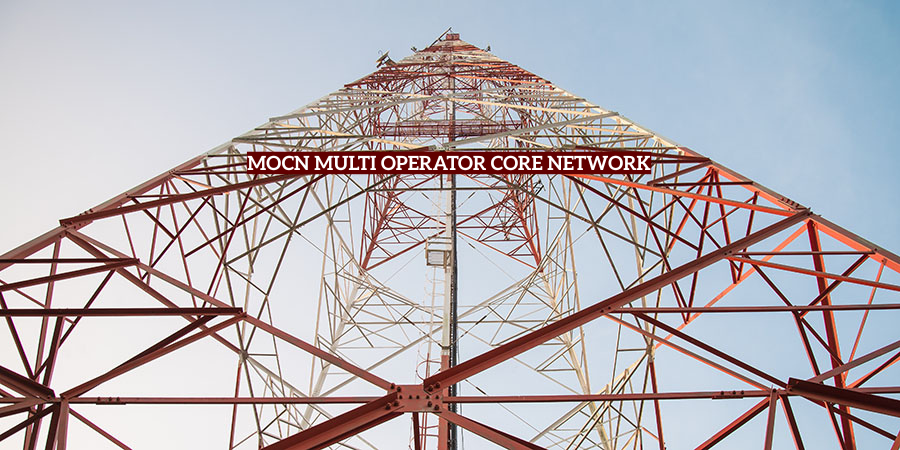
The mocn multi operator core network model is a mobile network sharing approach where multiple operators use shared radio infrastructure and sometimes shared spectrum while keeping their core networks separate. This reduces duplicated infrastructure, improves efficiency, and can extend coverage.
It has become more relevant with modern 4G and 5G rollouts. In 2026, Ericsson reported a VodafoneThree deployment combining MOCN with MORAN in a multi-vendor environment, showing how shared networks can evolve in real deployments.
What MOCN Really Means
The term mocn multi operator core network can be misleading because it does not mean operators fully merge networks. Instead, they share the radio access network while keeping separate core networks.
In practice, this means base stations and radio resources are shared, but each operator still controls its own authentication, billing, and service logic in its core network.
The shared radio layer connects users to the correct operator core using network identifiers defined in 3GPP standards. This allows multiple operators to coexist on the same physical infrastructure without losing independence.
Why Operators Share Infrastructure
Mobile networks are expensive to build and maintain. Operators must invest in sites, antennas, power systems, fiber backhaul, and spectrum licenses. In many regions, building separate networks leads to duplication.
Network sharing reduces these costs. Operators can split infrastructure investment and operational expenses while still competing in services and pricing.
The mocn multi operator core network model is especially useful for improving spectrum efficiency and expanding coverage in rural or hard-to-reach areas. However, better coverage does not automatically mean higher speeds, since performance still depends on congestion, spectrum width, and radio conditions.
| Field | Details |
|---|---|
| Full Form | Multi Operator Core Network |
| Category | Telecom / 5G Technology |
| Main Purpose | Mobile network sharing |
| Shared Resources | RAN infrastructure and spectrum |
| Core Networks | Usually kept separate |
| Related Technology | 4G LTE and 5G |
| Similar Model | MORAN |
| Main Benefit | Better infrastructure efficiency |
| Key Advantage | Improved resource and spectrum utilization |
| Common Use | 4G and 5G network sharing |
| Standardization | 3GPP |
| Key Challenge | Coordination and network management |
How the Architecture Works
The architecture is best understood by separating the network into two parts: the radio access network (RAN) and the core network.
The RAN includes equipment like eNodeB in 4G and gNodeB in 5G. In MOCN, this layer is shared between operators. Devices connect to the same physical radio nodes.
Behind the RAN, each operator maintains its own core network. This handles mobility management, authentication, policy control, and service delivery.
From a user perspective, the process is seamless. A phone connects to the strongest available signal, and the network routes it to the correct operator core automatically.
MOCN vs MORAN
MOCN and MORAN are both sharing models but differ mainly in spectrum usage.
In MORAN, operators share radio equipment but keep separate spectrum allocations. In MOCN, both radio infrastructure and spectrum can be shared.
This makes the mocn multi operator core network model more flexible in terms of capacity pooling, but also more complex to manage. Operators must coordinate how shared resources are used, especially during peak traffic.
Agreements typically cover capacity sharing, maintenance responsibilities, software upgrades, and fault handling. The right model depends on regulation, spectrum ownership, and business strategy.
VodafoneThree Deployment Example
In 2026, Ericsson announced that VodafoneThree had completed a network upgrade using both MOCN and MORAN across a multi-vendor 4G and 5G network.
According to Ericsson, the deployment improved coverage consistency and allowed better use of combined spectrum resources. It also helped reduce coverage gaps in previously underserved areas.
These results are vendor-reported, but they illustrate how network sharing can be introduced gradually rather than requiring a full network replacement.
For operators running mixed 4G and 5G environments, this staged approach is often more practical and cost-effective.
Technical Complexity in Practice
Although the mocn multi operator core network model sounds simple, real-world deployment is complex.
Shared radio infrastructure must serve customers from multiple operators simultaneously. This requires careful monitoring, fault isolation, and performance management across organizational boundaries.
Software updates are particularly sensitive. A change in shared equipment can affect all participating operators, so testing must cover the entire shared environment.
Capacity management is another challenge. Operators must agree on how resources are allocated during normal and peak demand periods.
As networks scale, automation and orchestration become essential to manage configuration, performance, and troubleshooting efficiently.
Operator Independence
Despite sharing infrastructure, MOCN does not remove operator independence.
Each operator retains its own core network, customer base, pricing, and service policies. This is a key advantage of the model.
Unlike deeper sharing approaches, such as GWCN, MOCN avoids merging core network functions. This allows operators to cooperate on infrastructure while remaining competitors in services.
For customers, the operator relationship remains unchanged even if parts of the underlying network are shared.
Customer Impact
From a user perspective, the main question is whether service improves.
Potential benefits include wider coverage, better spectrum utilization, and more consistent connectivity. In some areas, users may gain access to infrastructure that would not exist without sharing.
However, performance is not guaranteed to improve everywhere. Network speed and reliability still depend on local demand, radio conditions, and available capacity.
The most meaningful indicators for users remain coverage quality, stability, and service availability rather than the underlying architecture.
Future of MOCN in 5G
The mocn multi operator core network model is expected to remain important as 5G networks expand.
5G introduces more software-driven and flexible architectures, making it easier to separate shared infrastructure from operator-specific services.
It is also relevant for 5G Standalone deployments, where operators may upgrade radio and core systems at different times. Sharing helps reduce cost and speed up rollout.
Future improvements will likely focus on automation, better orchestration, and real-time network management to reduce operational complexity.
Ultimately, operators will continue using MOCN where it provides a clear balance between cost savings, performance, and control.
Final Takeaway
The mocn multi operator core network model provides a practical way for operators to share infrastructure while maintaining independence. It improves efficiency, supports wider coverage, and reduces duplication, but requires strong coordination and governance. As 5G networks grow, MOCN will remain a key tool for balancing cost, performance, and operational flexibility.
FAQs
Q: What is MOCN multi operator core network?
A: It lets operators share RAN resources and spectrum while keeping core networks separate.
Q: How does MOCN support 5G?
A: MOCN allows multiple operators to use a shared 5G RAN with separate core networks.
Q: What is the main benefit of MOCN?
A: It can improve infrastructure efficiency, coverage and spectrum utilization.
Q: How is MOCN different from MORAN?
A: MOCN can share spectrum, while MORAN generally keeps operator spectrum separate.
Q: Does MOCN combine operator core networks?
A: No. MOCN usually shares radio resources while operators retain separate core networks.